Guides for VHS, camcorder tapes, and video digitization
You can convert a home-made DVD to a digital file for free by copying its VIDEO_TS folder to your computer or by converting it to MP4 with HandBrake, which runs on Windows and Mac. You need a computer with a DVD drive, or an external USB drive for about $45–$55. Commercial movie DVDs are copy-protected, so these steps are for discs you recorded yourself. If you have a stack of discs, Capture converts them to MP4 for $19.99 per disc.
AI video upscaling works in three stages: the original tape is captured using broadcast-grade equipment to extract the cleanest possible signal, encoded into a lossless ProRes master file, then processed frame-by-frame by neural networks that remove interlacing artifacts and increase the resolution to 1080p or 4K. Unlike a standard 1:1 transfer, the AI analyzes each frame individually — inferring missing detail from surrounding pixels and learned patterns — while preserving the original frame rate throughout.
Film video cameras record motion by capturing a rapid sequence of still images on photographic film — typically at 24 frames per second for cinema and 16–18 fps for home formats like 8mm and Super 8. Unlike digital video, film requires chemical development before it can be viewed, and the footage degrades over time without proper cold, dry storage.
Super 8 projectors operate similarly to standard 8mm projectors but are not interchangeable — Super 8 film has a different sprocket hole size and frame dimension than regular 8mm. Kodak introduced Super 8 in 1965 alongside a cartridge-loading system that eliminated manual threading. Working Super 8 projectors are available used through eBay and estate sales, though lamp replacements are increasingly difficult to source.
Hi8 tapes play only on a Hi8 or Digital8 camcorder or a dedicated Hi8 deck, and none of these are made anymore, so you'll be buying used. A used player plus a $40–$90 capture device lets you watch and copy tapes at home. If you'd rather skip the hardware, Capture transfers Hi8 tapes to digital for $19.99 per tape, regardless of length.
Affordable video format conversion for physical media — VHS tapes, film reels, and camcorder tapes — starts at $12/tape through Forever Studios and $19.99/tape through Capture, with SD, FHD (1080p), and UHD (4K AI upscale) tiers at no price difference. DIY conversion using a USB capture card costs less upfront but requires a working VCR, technical setup, and hours of real-time recording. For most households with more than 5 tapes, professional mail-in delivers better quality at a lower effective cost per tape than DIY.
To play Hi8 tapes, you need a Hi8 or Digital8 camcorder — these tapes won't play in a standard VCR, and standalone Hi8 decks are rare. If you no longer have a camcorder, or you want to preserve the footage for good, the simplest option is a professional service that plays and digitizes the tapes for you. In fact, to convert Hi8 to digital without a camcorder at all, a professional Hi8-to-digital service is the only reliable route, since it supplies the playback equipment.
Old video cameras from the 1980s and 1990s recorded on VHS, VHS-C, 8mm, Hi8, or Betamax tape depending on the model and era. Most are no longer functional or have worn heads that produce degraded playback. If an old camera still works, it can be used to play back its native tape format directly into a capture device for digitization.
VHS stands for Video Home System, a name chosen by JVC to emphasize its intended use for everyday household recording and playback. JVC launched the format in Japan in 1976 and the United States in 1977, positioning it specifically as an affordable consumer alternative to professional video formats.
VHS won the format war over Betamax primarily because of longer recording times and open licensing to many manufacturers. Betamax, released by Sony a year earlier, offered slightly better picture quality but capped early recording at about one hour. By the time Sony extended its capacity, JVC's VHS had already locked up the retail and video-rental markets — cheaper, more widely available, and backed by more brands.
8mm video tapes require a Sony-compatible 8mm or Hi8 camcorder for playback since standard VCRs cannot read the format. New players are no longer manufactured, and sourcing working used hardware is increasingly difficult. For most people, professional digitization is the more practical way to access footage on these tapes today.
Before VHS, home video options included Sony's Betamax (1975), the Philips VCR format (1972), and Sony's U-matic (1971) which was primarily institutional. Earlier still, consumers could record home movies on film using 8mm or Super 8 cameras, but those required separate projection equipment to watch. VHS was the first format to combine affordable pricing, long recording times, and wide hardware availability into a true mass-market product.
The best-selling VHS titles of all time include The Lion King, Aladdin, Titanic, Home Alone, and Jurassic Park, each selling tens of millions of copies during the format's peak years. Disney releases consistently dominated VHS sales due to their appeal for repeated home viewing. Titanic remains one of the highest-selling individual VHS releases ever, with over 55 million copies sold worldwide after its 1998 home release.
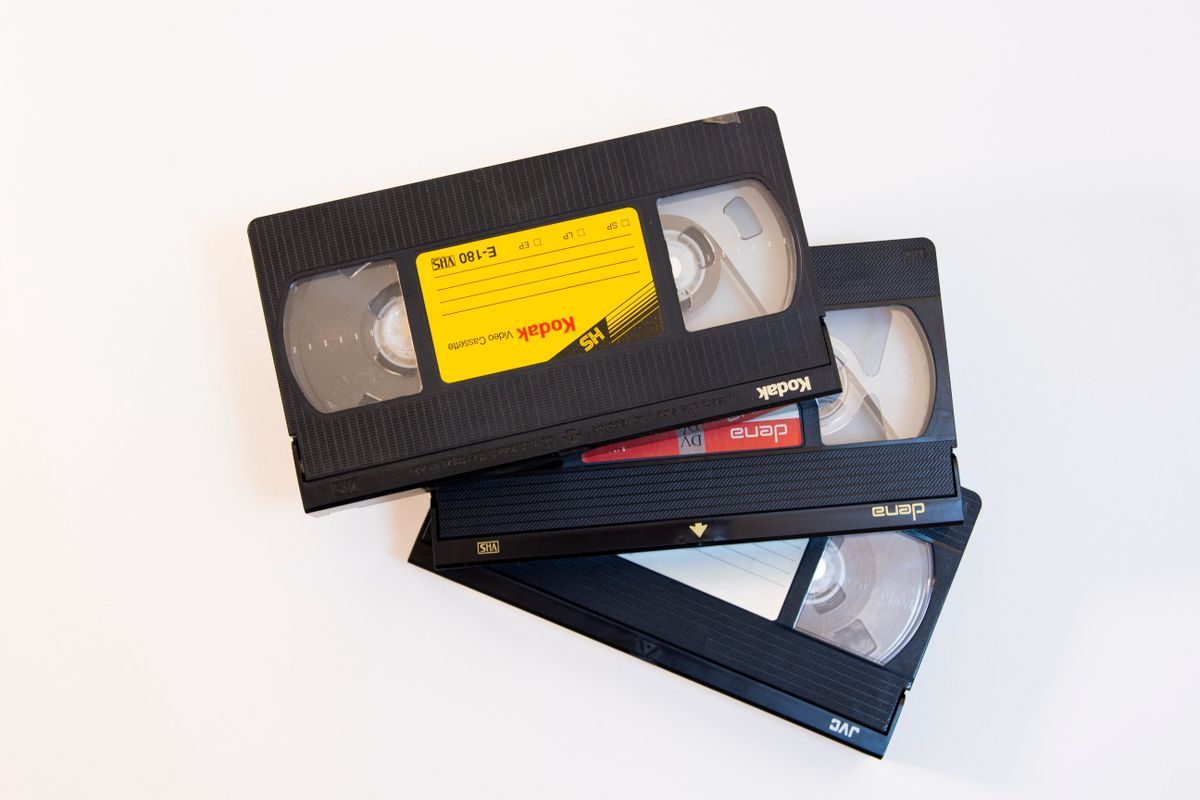
VHS tapes were produced in several formats — standard VHS, VHS-C, S-VHS, and S-VHS-C — that differ in size, recording capacity, and video quality. A full-size VHS cassette measures about 7.4 × 4.1 × 1 inches (188 × 104 × 25 mm) and records up to 2 hours at standard speed, while compact VHS-C camcorder tapes are roughly a third of the size. Knowing which type you have makes it easier to play, identify, and digitize your old tapes.
Store VHS tapes vertically (spine up, like books on a shelf) in a cool, dry room at 65°F or below with 30–50% relative humidity, away from direct sunlight and magnetic fields. Keep each tape in its original case or an archival polypropylene box. Avoid attics, garages, and basements — temperature and humidity fluctuations in these spaces accelerate tape degradation faster than any other factor.
Old Disney VHS tapes can be worth more than you think, but their value depends on the title, edition, and condition. This blog explains which Disney tapes collectors look for most, how to identify potentially valuable copies like Black Diamond editions, and what to know before selling or preserving them.
Betamax lost the format war primarily because VHS offered longer recording times — up to 6 hours compared to Betamax's initial 1 hour — which mattered more to consumers than Betamax's slightly better picture quality. JVC also licensed VHS more broadly to other manufacturers, flooding the market with compatible decks. By the mid-1980s, Betamax had lost enough retail shelf space that the outcome was effectively decided.
MiniDV emerged in the mid-1990s as one of the first consumer camcorder formats to record video digitally on tape. Its smaller cassette and improved image quality quickly made it popular among home video creators before newer recording technologies eventually replaced tape-based camcorders.
VHS is the tape format, while a VCR (Video Cassette Recorder) is the playback and recording device that reads VHS tapes. You cannot play a VHS tape without a VCR, but a VCR is also capable of playing other tape formats depending on the model. The terms are often used interchangeably in everyday conversation, but technically VHS refers to the cassette and VCR refers to the machine.
VCRs cost between $1,000 and $1,400 when they first reached U.S. consumers in the late 1970s, equivalent to roughly $5,000 to $6,500 today. Prices dropped steadily through the 1980s as competition increased, reaching around $200 to $400 by the late 1980s. That price drop is what made home movie recording accessible to mainstream families and created the enormous volume of VHS home footage that exists today.
Mold grows on VHS and video tapes when they are stored in humid environments above 50% relative humidity, feeding on the binder layer of the magnetic tape. Playing a moldy tape spreads the mold through the VCR and can permanently damage both the deck and the tape. Affected tapes should be cleaned by a professional before any playback attempt, and digitized immediately to prevent further deterioration.
8mm video tapes (Video8, Hi8 and Digital8) are larger cassettes from Sony's 8mm family, introduced from 1984; Video8 and Hi8 record analog video, Digital8 records digital video. MiniDV is a smaller, fully digital tape introduced in 1995. No camcorder plays both, so you need the right player or a transfer service; Capture digitizes either format for $19.99 per tape.
Some VHS tapes have sold for thousands of dollars on eBay, particularly early Disney black diamond clamshell editions, rare horror titles with limited print runs, and sealed factory copies of major releases. Value depends on condition, original packaging, and scarcity. Most common VHS tapes have little monetary value, but personally recorded home movie tapes hold irreplaceable sentimental worth that no resale market can quantify.
The most popular movies of the 1980s include E.T. the Extra-Terrestrial, Raiders of the Lost Ark, Back to the Future, The Empire Strikes Back, Ghostbusters, and Top Gun. The decade coincided with the rise of VHS, and most of these films were watched repeatedly on home tape. Many of those original VHS copies are still in family collections and regularly come up in digitization orders today.