
Format Guide
Video8 & Hi8: The Complete Guide to 8mm Videotapes
Details verified September 2026 · Digitization prices are live from checkout on the service page · All Capture facts
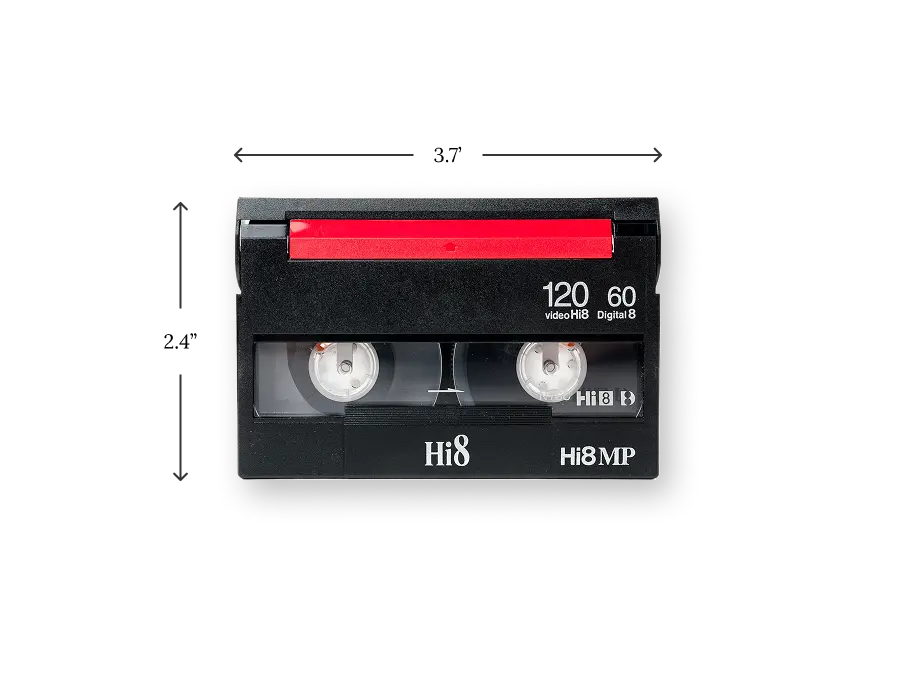
RELEASED YEAR
1989
RELEASED BY
Sony
MAX. RECORDING LENGTH
4 hours
RESOLUTION IN PIXEL
720 x 480
HI8 DIMENSIONS
3.75 x 2.25 x 0.75"
What is Video8?
Video8 (also written as Video-8) was introduced by Sony in 1984 as a compact consumer camcorder format. It used 8mm magnetic tape and was significantly smaller than VHS, making it popular for home movies throughout the late 1980s. Video8 tapes record in analogue and offer around 240 lines of horizontal resolution.
What is Hi8?
Hi8 was Sony's upgraded version of the Video8 format, launched in 1989. It delivered higher resolution (400 lines vs 240 lines) and improved colour reproduction, developed to compete with JVC's S-VHS format. Hi8 remained popular through the 1990s and into the early 2000s and is one of the most common camcorder formats found in home archives today.
The Compact Camcorder Revolution.
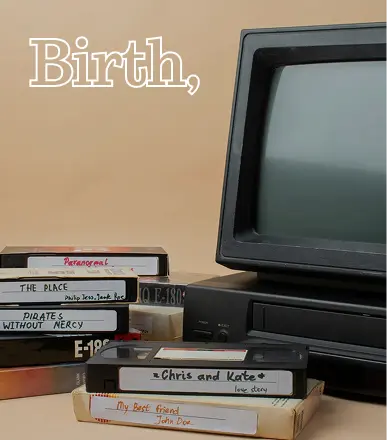
The Hi8 Upgrade
In 1989, Sony released Hi8 — a significant upgrade that boosted horizontal resolution from 240 lines to over 400 lines, rivalling S-VHS quality in a much smaller cassette. Hi8 became the prosumer standard, popular with amateur filmmakers and videographers who needed near-broadcast quality without professional equipment. The format also introduced improved colour reproduction and S-video output.
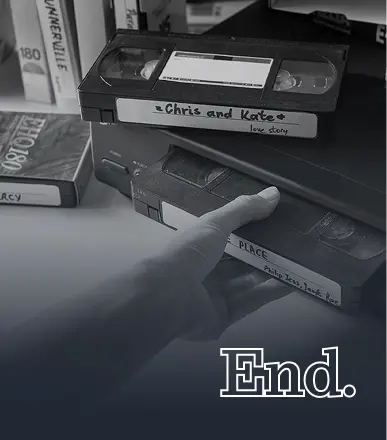
Its Birth
Sony introduced the Video-8 format in 1985 as a compact alternative to full-size VHS and Betamax tapes. Designed specifically for camcorders, the smaller cassette allowed handheld recording for the first time. Video-8 quickly became the standard for home camcorders through the late 1980s, capturing birthday parties, holidays and everyday family moments in a pocket-sized tape.

End of an Era
Sony launched Digital-8 in 1999, recording DV-quality digital video onto the same familiar 8mm cassette shell. However, the rise of MiniDV, followed by tapeless digital cameras and smartphones, made the entire 8mm tape family obsolete by the mid-2000s. Today, millions of Video-8 and Hi8 tapes sit in drawers worldwide, holding irreplaceable family memories at risk of oxide deterioration.
Three Generations of 8mm Video
The 8mm Format Timeline.
Video8
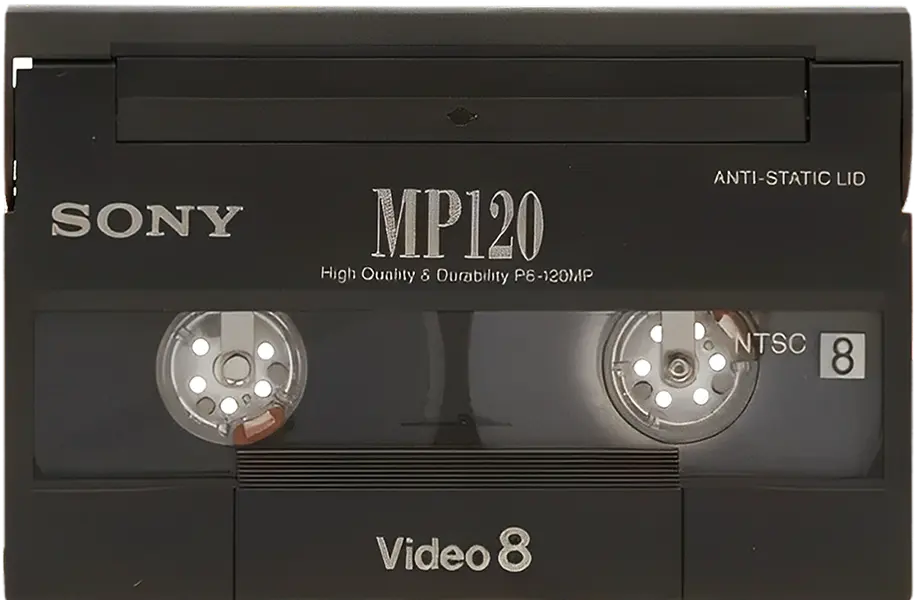
Sony introduced Video8 as a compact consumer camcorder format — significantly smaller than VHS and designed for handheld recording. It quickly became the go-to format for home movies.
The cassette shell is plain black or dark grey. The label reads "Video8" or "V8". Typically recorded before 1990.
Video8
The Original
Sony introduced Video8 as a compact consumer camcorder format — significantly smaller than VHS and designed for handheld recording. It quickly became the go-to format for home movies.
The cassette shell is plain black or dark grey. The label reads "Video8" or "V8". Typically recorded before 1990.
Hi8
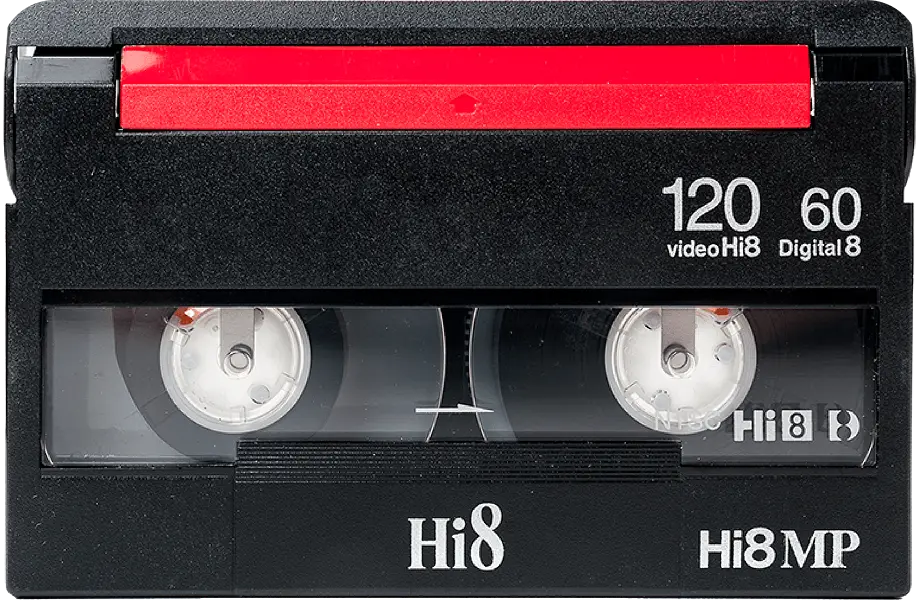
Hi8 boosted resolution to over 400 lines with improved colour reproduction, competing directly with S-VHS in a much smaller cassette. It became the prosumer standard for nearly a decade.
Looks identical to Video8 but the label clearly reads "Hi8" or "Hi8 MP". Recorded between 1989–2005.
Hi8
The Upgrade
Hi8 boosted resolution to over 400 lines with improved colour reproduction, competing directly with S-VHS in a much smaller cassette. It became the prosumer standard for nearly a decade.
Looks identical to Video8 but the label clearly reads "Hi8" or "Hi8 MP". Recorded between 1989–2005.
Digital8
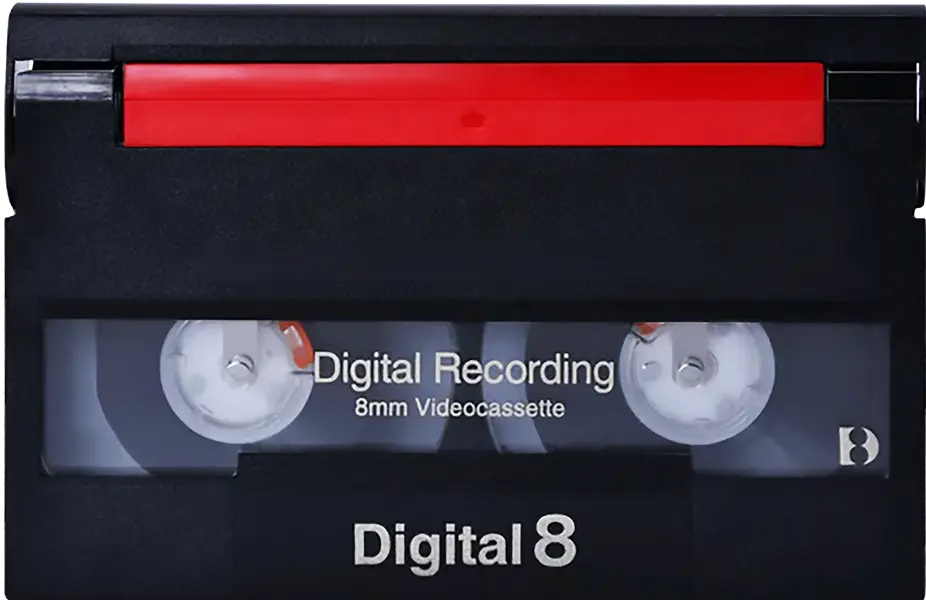
Digital8 brought DV-quality digital recording to the familiar 8mm cassette shell — the best picture quality of the three. However, the rise of MiniDV and tapeless cameras ended the 8mm era.
The label reads "Digital8" or "D8" and often features a blue accent stripe. Requires different playback equipment.
Digital8
The Final Chapter
Digital8 brought DV-quality digital recording to the familiar 8mm cassette shell — the best picture quality of the three. However, the rise of MiniDV and tapeless cameras ended the 8mm era.
The label reads "Digital8" or "D8" and often features a blue accent stripe. Requires different playback equipment.
How long can 8mm tapes be preserved?
Tape Degradation.
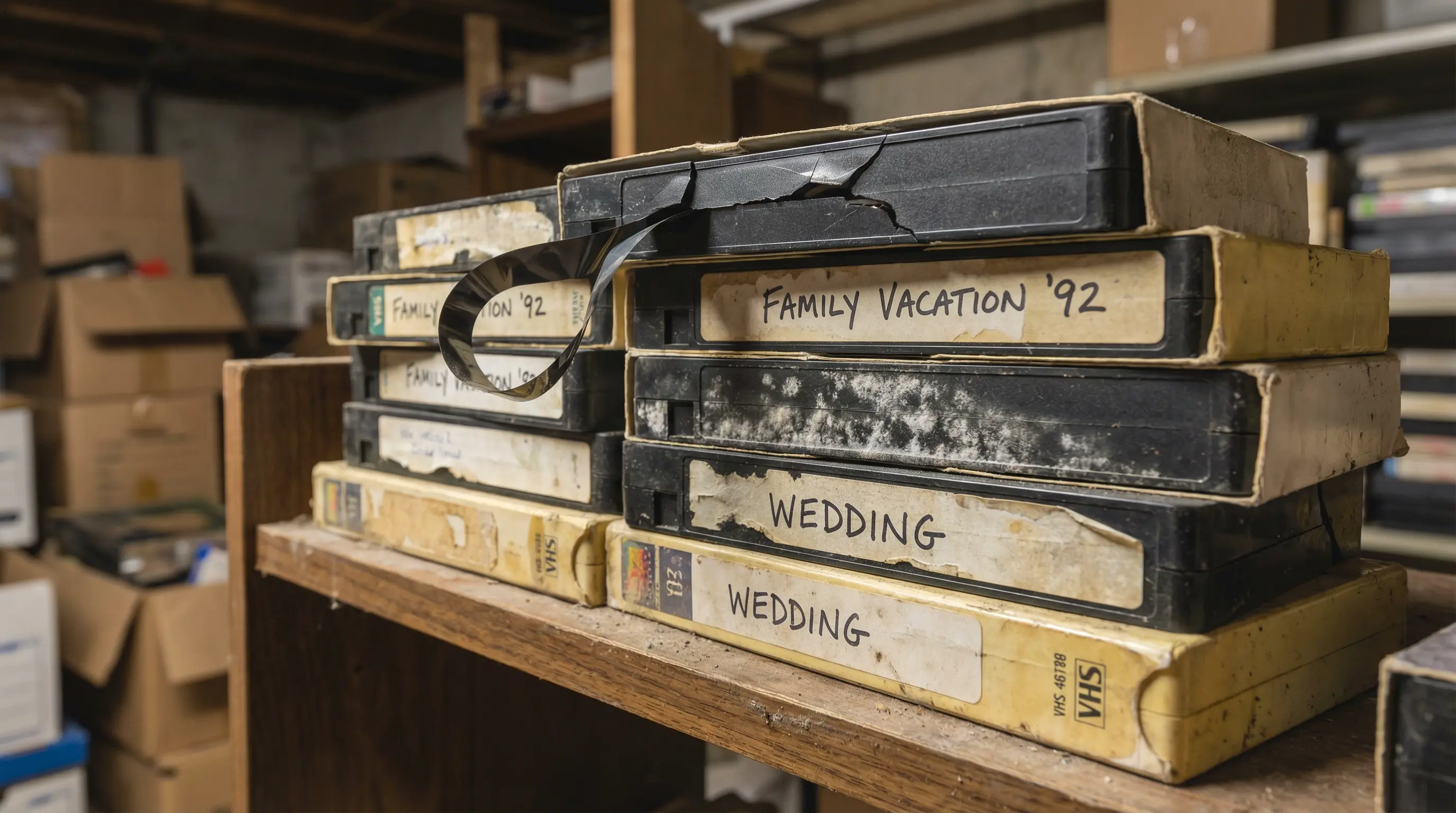
Tape Deterioration
8mm tapes use a narrower magnetic tape than VHS, making them more susceptible to degradation. Over time, the metal-evaporated or metal-particle coating can suffer from oxide shedding and sticky-shed syndrome, causing dropouts, colour loss and audio distortion. Most 8mm tapes begin showing noticeable degradation after 15–20 years, especially if stored in humid or warm conditions.
Mould or Tape Breakage
The compact housing of 8mm tapes can trap moisture, promoting mould growth. Because the tape is thinner than VHS, it's also more prone to snapping or creasing during playback in aging camcorders. Professional repair can often salvage these tapes through careful cleaning, splicing and baking treatments.
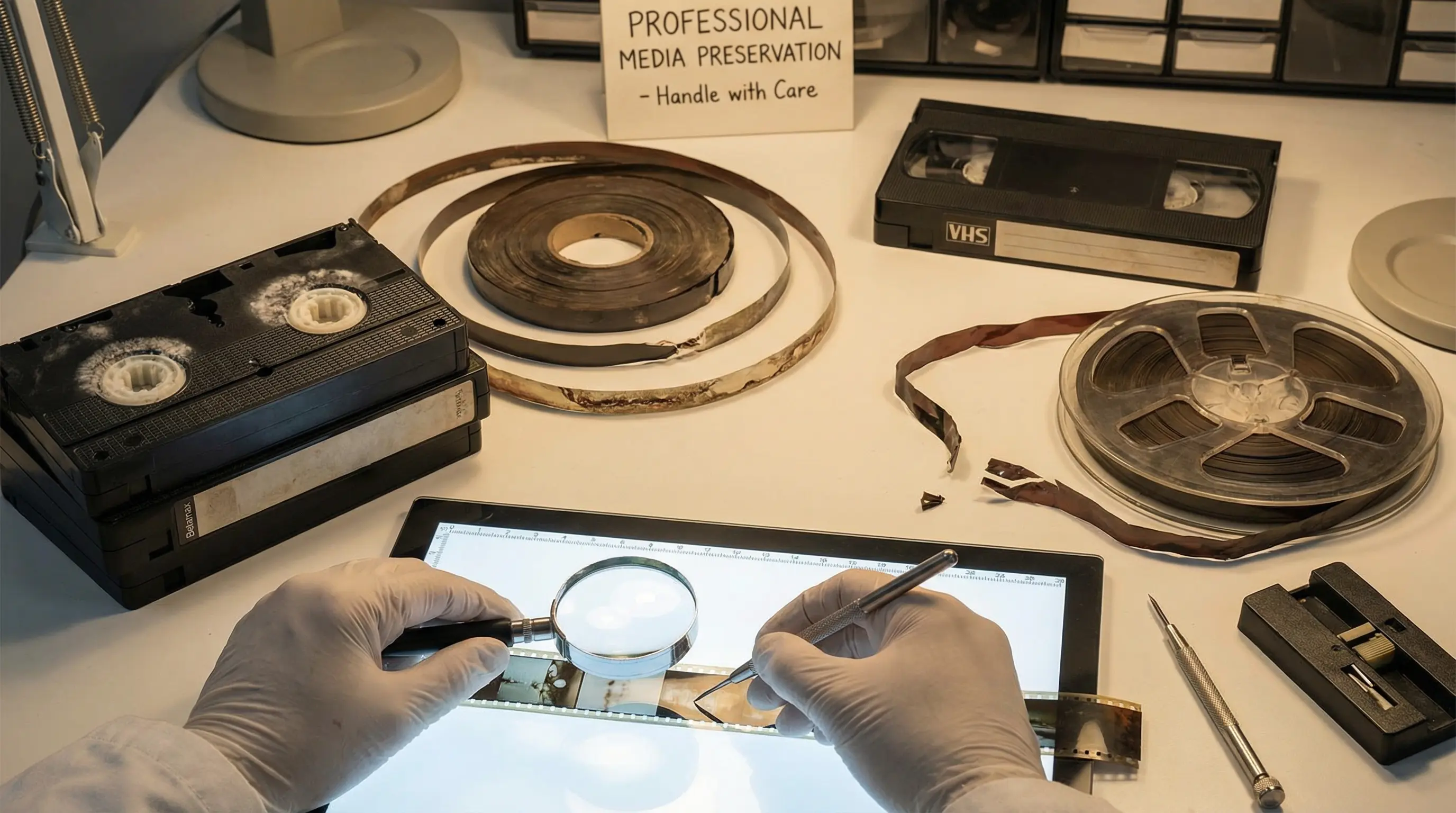
How to keep 8mm tape content intact?
Extend Tape Life.
Avoid Moisture and Heat
Store tapes in a cool, dry environment with humidity between 40–60% and temperature between 50–65°F (10–18°C). Fluctuations in temperature cause the tape's magnetic coating to expand and contract, accelerating degradation. Never store tapes in attics, basements, garages, or near windows where conditions change seasonally.
Store Vertically, Not Horizontally
Always store Hi8 and Video8 tapes standing upright on their edge — never lying flat. Horizontal storage puts uneven pressure on the tape reels over time, causing warp and edge damage that can eventually make playback impossible.
Rewind Before Long-Term Storage
Before putting tapes away for an extended period, fully rewind them to the beginning. Tapes left mid-way experience uneven tension across the reel, which can cause stretching and print-through — where audio or video from one tape layer bleeds into the adjacent layer.
Keep Away From Magnetic Fields
Magnetic fields from speakers, motors, and household electronics can partially erase or corrupt tape content over time. Store tapes at least 6 inches away from televisions, computers, stereo systems, and power adaptors.
The Only Permanent Solution: Digitize
No storage method stops degradation permanently. Video8 and Hi8 tapes experience 10–20% quality loss — fading, reduced audio clarity, and loss of picture — within 10–25 years even under ideal conditions. Digitizing your tapes is the only way to fully preserve the content before it deteriorates beyond recovery.
What are the benefits of digitising 8mm tapes?
8mm Memories Back to Life.
Tape Revival
Our 8mm tape digitization service preserves your camcorder memories with no time limit per tape. If mold or tape breakage issues are discovered before or during the digitization process, our team handles cleaning and splicing to give your tapes the best possible chance.
Post-Digitization Destruction Methods
If you no longer need your physical tapes after digitization, there are secure disposal options available:
- 1
Using a degausser: disrupts the magnetic particles on the tape with a strong magnetic field, permanently deleting the data.
- 2
Physical destruction: shredding the tape to ensure the data cannot be recovered.
What our customers say
Memories Preserved by Capture.
"I was finally able to watch the videos I made of my son when he was a baby. They did an excellent job of transferring the video from mini tape to DVD."
Laura H.
Google Review
"The wonderful memories of 40 years ago to present day! To see and hear all the adventures again, the different chapters of our lives, its so amazing."
Patricia C.
Google Review
"I appreciate how you were able to capture a long lost family video in good form. To bring back old memories is priceless and awesome for the family to watch."
C. R.
Google Review
Frequently Asked Questions.
Can I still play Video8 and Hi8 tapes?
Technically yes, but finding working playback equipment is increasingly difficult. Sony stopped manufacturing Hi8 camcorders in the early 2000s and most units still in existence are ageing and unreliable. Attempting to play a degraded tape on old equipment can cause further damage or complete tape breakage. If you want to view old footage, digitising first is the safer option.
How do I know if my Hi8 tape is damaged?
Common signs of tape damage include a musty or vinegar-like smell indicating mould or acetate deterioration, visible white or black spots on the tape surface, a stiff or sticky tape that doesn't move freely through your fingers, a cracked or warped cassette shell, and previous playback that produced distorted or unwatchable video. If any of these apply, do not attempt to play the tape.
What is the difference between Video8, Hi8, and Digital8?
All three use the same physical 8mm cassette size but differ in recording technology. Video8 is the original analogue format with the lowest resolution at around 240 lines. Hi8 improved on this with higher resolution (400 lines) and better audio quality. Digital8 records digital video onto the same tape, delivering the sharpest picture of the three. All three formats can be digitized.
How long do Hi8 and Video8 tapes last?
Under ideal storage conditions, Hi8 and Video8 tapes can last 25–30 years before significant degradation occurs. However most tapes recorded in the 1980s and 1990s are already within or past this window. Poor storage conditions — heat, humidity, dust, or magnetic interference — accelerate the process considerably. If your tapes are over 20 years old, the time to act is now.
What causes Hi8 tape to go bad?
The primary causes of Hi8 tape degradation are humidity causing mould growth on the magnetic coating, heat causing the binder that holds magnetic particles to the tape to break down (a condition known as sticky shed syndrome), physical stress from improper storage or repeated playback, and magnetic interference from nearby electronics gradually erasing the recorded signal.
Can mouldy Hi8 tapes be recovered?
In many cases yes, but it requires professional cleaning before the tape can be safely played or digitized. Attempting to play a mouldy tape will spread the mould further and can permanently destroy content. Professional tape repair services can clean and restore mouldy tapes, though severely affected sections may be unrecoverable.
What format will my digitized video be saved in?
Video8 and Hi8 tapes are typically digitized and saved as MP4 files, which are compatible with all modern devices including iPhones, Android phones, Mac, and Windows computers. MP4 files can be easily shared, uploaded to cloud storage, and played on any TV or computer without special software.
Is it better to digitize Video8 tapes myself or use a professional service?
DIY digitization is possible using a Video8 or Hi8 camcorder connected to a computer via a capture card, but it requires working playback equipment, technical setup, and real-time capture (a 2-hour tape takes 2 hours to capture). Professional services have calibrated equipment, handle tape repairs, and produce higher quality results. For tapes with sentimental or irreplaceable content, professional digitization significantly reduces the risk of loss.
What are the different types of 8mm tapes?
The 8mm tape family includes three formats: Video8 (the original analogue format introduced in 1984), Hi8 (the improved analogue format from 1989 with higher resolution), and Digital8 (the digital format introduced in 1999). All three use physically identical cassettes but are not interchangeable in terms of playback — each requires a compatible device to play correctly.
How should I pack and ship Hi8 tapes safely?
Wrap each tape individually in bubble wrap or a soft cloth. Place tapes in a rigid cardboard box with firm padding on all sides. Do not use loose packing peanuts alone as they allow movement during transit. Label the box "Fragile — Magnetic Media", avoid sending in extreme heat, and use a tracked shipping method so you can confirm safe delivery.
Will my original tapes be returned after digitization?
Yes, original tapes are returned after digitization unless you specifically request destruction. If you no longer need the physical tapes, professional destruction options include degaussing — which uses a strong magnetic field to permanently erase all data — and physical shredding to ensure content cannot be recovered.
Why are my Hi8 tapes making a squeaking sound when played?
A squeaking or squealing sound during playback is a classic symptom of sticky shed syndrome, a condition where the tape binder deteriorates and causes the tape to drag against the playback heads. This is a warning sign that the tape is degrading and should be treated by a professional before further playback causes permanent damage.
Explore Other Tape Formats.

Explore Our Other Services.
We digitize all your analog media — mix and match in one order.
Video-8 / Hi-8
Est. $0.00
Video-8 / Hi-8