DV / DVCAM
Details verified September 2026 · Digitization prices are live from checkout on the service page · All Capture facts
YEAR RELEASED
1995
RELEASED BY
Sony & Panasonic
MAX. RECORDING LENGTH
80 min (SP)
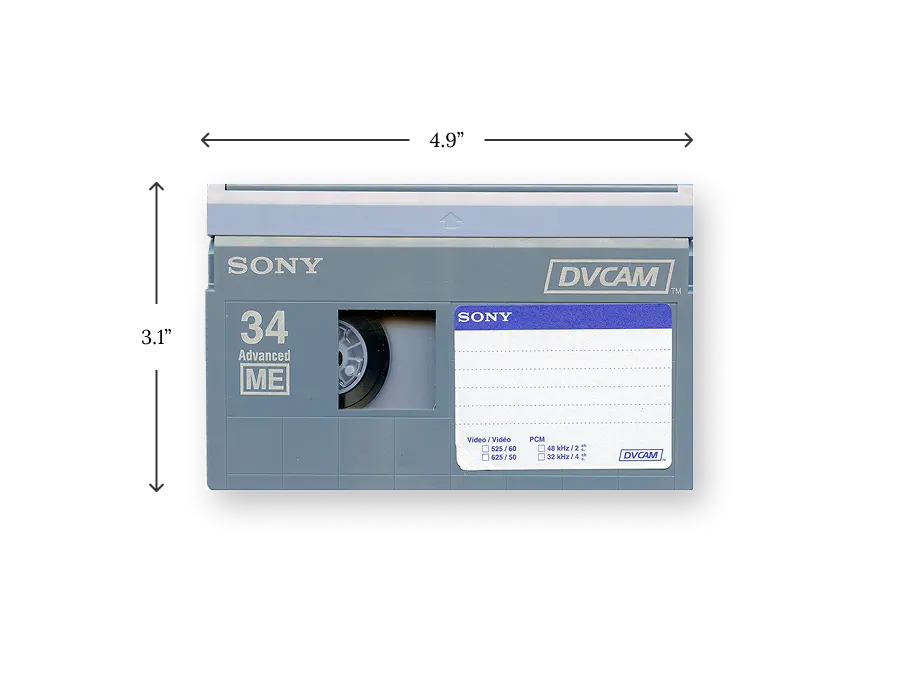
CASE DIMENSIONS
97.5 × 64.5 × 14.6 mm
RESOLUTION
720 H × 480 V
The Format the Industry Finally Agreed On.
The Professional's Choice
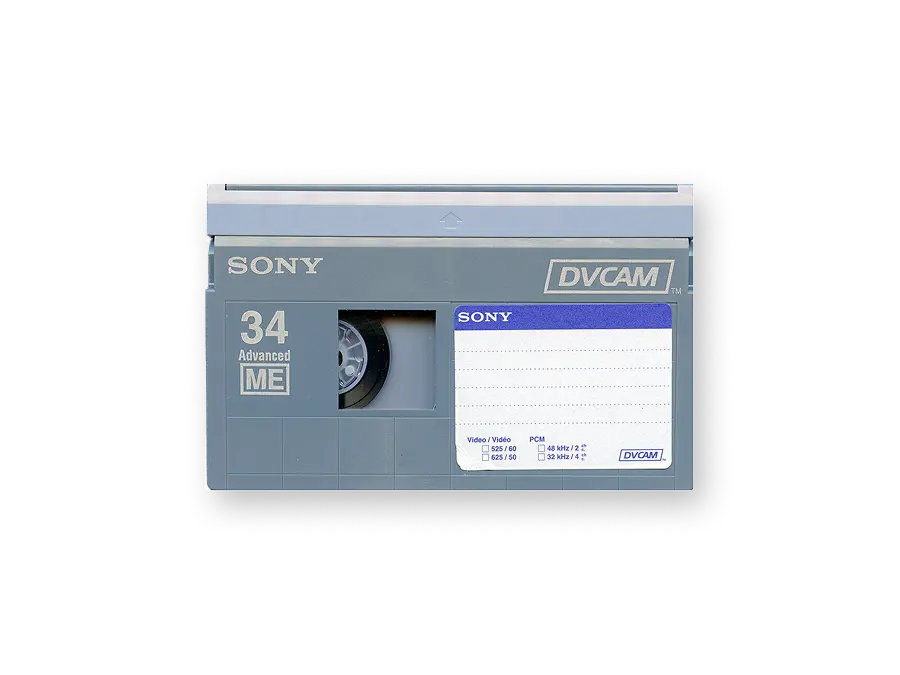
Full-size DV cassettes were adopted by broadcast crews, documentary filmmakers, and event videographers who needed reliability in the field. Sony's DVCAM variant and Panasonic's DVCPRO offered enhanced durability for professional production. The IEEE 1394 (FireWire) interface allowed lossless transfer to a computer with no quality loss — a capability that made DV the backbone of non-linear editing in the late 1990s and 2000s.
Born from a Consortium
DV (Digital Video) was developed in 1995 by a consortium of over 55 consumer electronics companies — led by Sony, Panasonic, and JVC. Unlike the VHS vs. Betamax era, the industry agreed on a single open standard from the start. The result was a shared digital video format that worked across camcorders from dozens of manufacturers, recording native digital video at 25 Mbps — a leap over any analog format that came before it.
Surpassed by Flash Memory
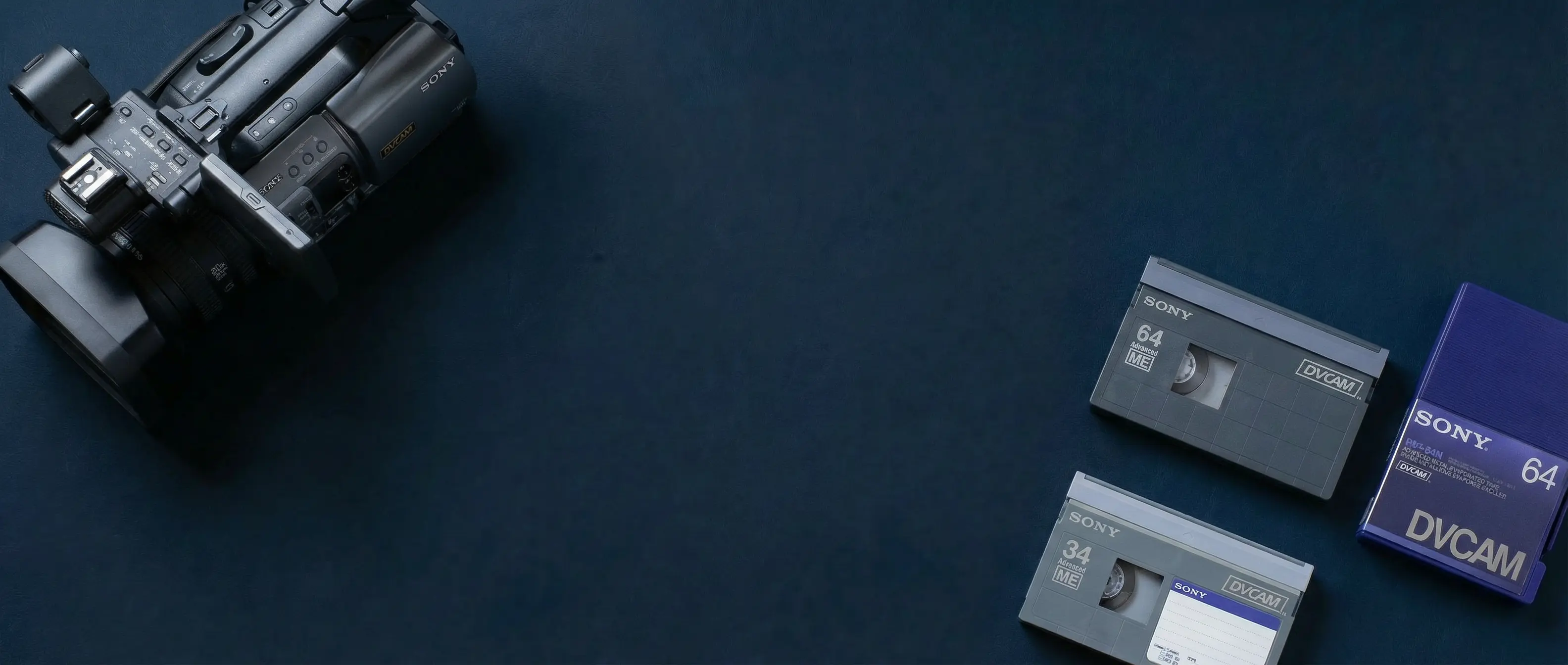
DV tape held its own well into the 2000s, but the rise of hard drive-based and flash-memory camcorders ultimately ended its production run. When tapeless acquisition became affordable and reliable, the industry moved on. Today, warehouses, studios, and private collections hold thousands of DV tapes — many containing irreplaceable footage that can only be recovered with the right playback hardware and digitization expertise.
One Codec, Four Cassette Sizes
The DV Format Family.
All DV variants share the same digital video codec — 25 Mbps, 720 × 480 (NTSC) or 720 × 576 (PAL). What differs is the cassette size, tape speed, and the market each variant was built for.
| Variant | Cassette | Dimensions | Capacity | Market |
|---|---|---|---|---|
| DV | Medium (standard) | 97.5 × 64.5 × 14.6 mm | SP: 80 min / LP: 120 min | Consumer / Prosumer |
| DVCAMThis format | Medium (standard) | 97.5 × 64.5 × 14.6 mm | SP: 40 min (faster tape speed) | Broadcast / Professional |
| DVCPRO | Large | 172 × 102 × 14.6 mm | Max 126 min | Broadcast / Field |
| MiniDV | Small (compact) | 66 × 48 × 12.2 mm | SP: 60 min / LP: 90 min | Consumer / Indie |
Larger Than MiniDV, Built for the Field
At 97.5 × 64.5 × 14.6 mm, the standard DV cassette is noticeably larger than MiniDV — built for the rigors of professional field work and broadcast production. DVCAM uses the same cassette shell but runs the tape at a higher speed, giving it a wider track pitch and greater resistance to dropouts. Both formats record at 720 × 480 resolution (NTSC) using 6.35mm metal evaporated tape.
FireWire Was the Key
DV tapes transferred to a computer via IEEE 1394 (FireWire), a high-speed interface that could carry the full 25 Mbps DV stream without compression or quality loss. This made DV the first consumer format capable of true lossless digital capture — but FireWire ports have all but disappeared from modern computers. If you still have DV tapes, specialized playback hardware and a working DV deck are now required to access that footage.
How long can DV tapes be preserved?
DV Tape Lifespan.
Digital Format, Analog Problem
Despite recording in digital format, DV tapes are still magnetic media — and magnetic media degrades. Over time, the metal evaporated coating sheds microscopic oxide particles, causing dropouts (missing blocks of video data). DV tapes stored in humid or warm conditions can develop mold on the tape surface within 10–15 years. Even well-stored tapes typically show 10–20% degradation within 20–25 years.
Dropouts: The Invisible Threat
Unlike analog tape degradation — which fades gradually — DV dropouts are binary: a corrupted block of digital data produces a visible mosaic artifact or a completely frozen frame. A tape that plays perfectly today can develop dropouts within months if stored poorly. Professional tape restoration and error-correction processing can often rescue footage with early-stage dropout damage before it becomes permanent.
How to keep DV tape content intact?
Extend Tape Life.
Avoid Moisture
Store tapes in a dry environment. DV tape uses a thin oxide layer that is highly susceptible to mold when exposed to humidity.
Keep in a Cool Place
Avoid direct sunlight and high temperatures. Heat accelerates oxide shedding, which causes permanent dropout damage.
Digitize Before It's Too Late
DV tapes degrade silently. Converting to a digital file now preserves every frame at native quality before dropouts appear.
Frequently Asked Questions.
What is a DV tape?
DV (Digital Video) is a tape format standardized in 1995 by a consortium of electronics manufacturers. Full-size DV cassettes are larger than MiniDV and were used primarily in professional and prosumer camcorders. They record digital video at 25 Mbps — the same DV codec used by MiniDV and DVCAM.
What is the difference between DV, DVCAM, and DVCPRO?
All three use the same DV video codec but differ in tape speed, cassette size, and target market. Standard DV was aimed at consumer and prosumer use. DVCAM (Sony) runs the tape faster for a more reliable track pitch, making it preferred for broadcast. DVCPRO (Panasonic) uses a larger cassette and metal-particle tape designed for demanding field production.
How do I play a DV tape today?
You need a DV or DVCAM deck or camcorder and a FireWire (IEEE 1394) port to capture the signal. This hardware is increasingly rare and difficult to maintain. The most practical option is to send your tapes to a professional digitization service like Capture, which has the decks and expertise to extract your footage reliably.
Can damaged or moldy DV tapes be recovered?
In many cases, yes. Common issues like mold, broken cassette shells, and tape dropouts can often be addressed before digitization. The success of recovery depends on the extent of damage and storage conditions. If you suspect your tapes are deteriorating, act quickly — degradation continues over time.
What digital formats will my DV tapes be converted to?
Your DV tapes are delivered as MP4 files (H.264), which play on any modern device. SD extraction preserves the original DV-quality signal; FHD and UHD options apply AI upscaling for sharper results. Files are delivered via cloud download or saved to a USB flash drive.
Explore Our Other Services.
We digitize all your analog media — mix and match in one order.