Celebrating Black History Month: Through the Camera Lens
Content team: Add a 2-3 sentence summary/excerpt for this post to improve SEO and reader engagement.

It’s practically given today that images and photography are integral to every facet of daily life: from selfies and snapshots of daily life to pivotal moments of social change like the protests and police brutality. But do you know the link between photography and civil rights dates back to Frederick Douglass, the famous former slave, abolitionist, orator, writer, and post-civil war statesman?
Frederick Douglas

In 1841, Frederick Douglass sat for his first photo portrait—one of at least 160 he would sit for in his lifetime. He loved photography and sought it out as often as he was able. He used it to curate his political persona. In fact, Douglass was the most photographed American in the 19th century—even more photographed than President Abraham Lincoln. Most importantly, Douglass recognized the power of photography to help end slavery and further civil rights by revealing the humanity of black Americans and conveying truth.
While Frederick Douglass may have been the most photographed African-American of his time, he is far from alone in spending time in front of the camera and using the power of the photograph to further civil rights and equality.
Pictures With Purpose

Left: Ambrotype of Frederick Douglass, 1855-1865. Right: Daguerreotype of a woman with a child on her lap, 1839-1865. Smithsonian National Museum of African American History and Culture
Pictures with Purpose is the seventh book in the Smithsonian museum’s photo series, “Double Exposure. ” The series shares some of the museum’s collection of over 25,000 rare photographs. Pictures with Purpose dives deep into the museum's archives to unearth some of the earliest pictures documenting the African American experience. The book focuses on photographs from the turn of the century, when African-Americans were reconciling the painful aftermath of slavery and creating a new identity and path forward for themselves in the country.
In a Smithsonian Magazine blog on the book, Laura Coyle Coyle, the head of cataloging and digitization at the Smithsonian National Museum of African American History and Culture and a contributing author of the book, says photography enabled African-Americans to reshape the narrative. “For the African-American community, photography was particularly important, because when they were in control of the camera, they had a chance to shape their own image for themselves, for their community and for the outside world in a way they normally didn’t have a chance to do in society,” she says. “Often, [African-Americans] were subject to racism and stereotypes and denigrating situations, but in photography, they could portray themselves as they were and as they aspired to be.”
Addison Scurlock and Sons Photography Studio
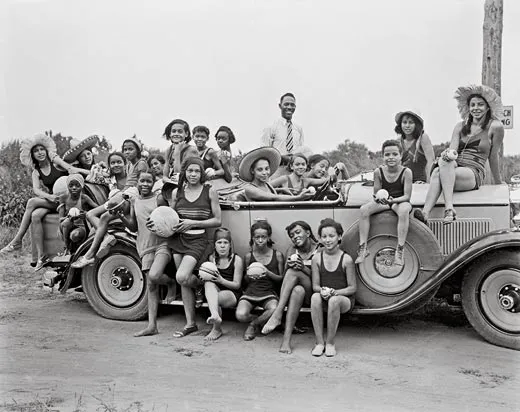
Group portraits were a Scurlock specialty (picnickers from Camp Clarissa Scott at Highland Beach, Maryland, in 1931). Scurlock Studio / Archives Center / NMAH, SI
In 1900, Addison Scurlock moved to Washington DC with his parents. Only 17 years of age, he listed “photographer” as his profession in that year’s census. Addison spent a couple of years apprenticing with a white photographer before starting his own studio in his parents’ home. Within a few years, he opened a photo studio on U Street, the hub of Washington’s African-American community.
The Scurlock Studio grew as the city became a home base for black artists and thinkers. It captured middle-class black life in the city for a full 50 years, from 1911 into the 1970s. Addison and his two sons documented the everyday events in community member’s lives: baby pictures, weddings, graduations, portraits, baptisms, balls. After the studio’s closure in 1994, over 250,000 negatives and 10,000 prints entered the Smithsonian’s archives.
It is thanks to the foresight and hard work of those above and countless others, professionals and amateurs alike, that we are able to look back on memories that capture and celebrate the African American community, even from its earliest days.
Want to dive in deeper? Here are a few great places to start:
Ten Black Photographers Who Shaped History
Nine Trailblazing Black Photographers Who Captured Groundbreaking Moments in History
It is thanks to the fascinating hard work of preservation experts at the Smithsonian and other institutions across the globe that these memories are and will be here now and for generations to come. What about your own memories? If you are concerned about preserving them for future generations, our digitizing experts are here to help.
You May Also Like

How to Transfer a CD to a USB Flash Drive: Music, Photos, and Files
To transfer a music CD to a USB flash drive, you have to rip it first: import the tracks as MP3 or AAC files with Windows Media Player or Apple Music, then copy those files to the drive. Dragging tracks straight from the disc only copies 44-byte ".cda" shortcuts that won't play, while photo and data CDs can be copied and pasted directly. A 16GB flash drive holds about 100 albums as 320 kbps MP3.

Does Walgreens Transfer VHS Tapes and Photos to Digital? What to Know Before You Decide
Yes, Walgreens transfers VHS tapes, film, photos, negatives, and slides to digital — but the work is outsourced to iMemories, not done in-store. Video converts to DVD, Blu-ray, or cloud; photos convert to USB only. Turnaround typically runs 3–5 weeks.
Forever Studios Reviews 2026: Is It Worth It? Quality, Pricing & Comparison
Yes, Forever Studios is a legitimate digitizing service. Based in Boca Raton, Florida, it specializes in transferring VHS tapes, camcorder tapes, film reels, photos, slides, negatives, and audio cassettes to digital formats. Most Forever Studios reviews praise the company's restoration quality and careful handling of sentimental media. The most common criticisms focus on quote-based pricing, longer-than-expected turnaround for some orders, and uncertainty over whether the Forever Gold upgrade delivers enough additional value. If preserving aging videotapes is your priority, Capture's VHS to Digital service includes published pricing, AI-enhanced restoration, and predictable turnaround times, making it easier to compare before placing an order.